Red Light Protocols

    Pick a condition — get the recommended protocol and research background in one tap.

    Evidence level Strong evidenceModerate evidencePreliminary evidenceWeak evidence

    Protocol times are based mostly on laser (LLLT) studies. With LED panels, effects may take a longer treatment period — times are conservative estimates.

    Wavelength:

    Most popular

    Pain & MSK

    Conditional protocol

    Eyes and vision — conditional protocol

    This is the only protocol on this page that does not suit everyone or every device. The conditions are not caveats but prerequisites for use. Read them first.

    Device requirement

    The 850 nm near-infrared must be turned off. This is not a recommendation but a prerequisite. Near-infrared is invisible, so the blink reflex and pupil constriction do not limit exposure. Visible 660 nm red is self-limiting — it is bright enough that you will not stare at it for long. If your device cannot switch off one wavelength, this protocol is not used.

    Who it is for — all conditions must be met

    • You are over 40. In the studies the effect appeared in the ageing retina, not in the young.
    • You have no diagnosed eye disease. Macular degeneration, diabetic retinopathy, glaucoma and retinal disease belong with an ophthalmologist — including when light therapy is being considered.
    • You are not using photosensitising medication.
    • You are not pregnant. There is no known risk, but there is no research either.

    What is not known about this device

    The retinal safety limit is not based on dose (J/cm²) but on radiance — the brightness of the source, which is preserved through the eye's optics. Manufacturers report irradiance because panels are designed for the skin. Radiance is not reported. In practice this means the dose can be calculated correctly, but the safety margin cannot. The devices used in the studies were roughly 2.5 cm across and delivered 8–40 mW/cm². A large panel is a different geometry. That is why the durations in this protocol are shorter than in the studies, not longer — the dose is the same, the power is greater.

    Protocol

    Wavelength
    660 nm alone, 850 nm off
    Distance
    30 cm or further
    Duration
    20–60 seconds
    Dose
    about 1.5–5 J/cm²
    Frequency
    once per day
    Timing
    morning, before 11:00
    Eyes:open, gaze toward the light. Closed lids block most of the red light, and the effect seen in the studies is not obtained. If the protocol feels uncomfortable, that is a reason to stop — not a reason to keep the eyes closed.

    Why longer is not better

    Jeffery's group has found that the effect behaves as a threshold rather than a dose-response: once the threshold is crossed, the benefit lasts about five days. A larger dose does not produce a larger effect. This is the most important point in the protocol — there is no reason to extend the session.

    When to stop

    • Afterimages or blurred vision that do not clear within a few minutes
    • Any change in vision
    • Eye pain or headache after the session

    In these cases stop and contact an ophthalmologist.

    Research background

    Glen Jeffery's group at University College London has shown that 670 nm light improves cone-cell colour-contrast sensitivity in people over 40, and that the effect is strongest in the morning. Andrew Huberman, professor of neurobiology and ophthalmology at Stanford, discusses the same protocol: about 30 cm distance, 2–3 minutes, in the morning, for people over 40. Clinical studies at 8–40 mW/cm² have not reported adverse effects. The evidence concerns the method, not this device.

    Boundaries

    What this device is not used for

    Some of the most promising research areas for red light require a different kind of device than this panel. For the sake of honesty, we also tell you where we do not recommend this device.

    Oral mucosa

    What research says
    This is one of the strongest evidence areas in photobiomodulation. For oral mucositis caused by cancer treatment, light therapy is in international clinical guidelines, and there is also evidence for canker sores and burning mouth syndrome.
    Why not with this device
    Dosing uses an intraoral tip placed directly against the mucosa at just a few J/cm² per point. A panel does not reach the mucosa and does not pass through the cheek at a therapeutic dose. The TMJ protocol on this page works because it targets the joint and masseter beneath the skin — not the mucosa.
    Do this instead
    Oral mucosa problems belong with a dentist or specialist care using a device designed for the purpose.

    Thyroid

    What research says
    In Höfling's randomised trial, 830 nm light therapy for Hashimoto's thyroiditis gave promising results: 47.8% of patients no longer needed levothyroxine at nine-month follow-up, and at six years the treatment was found to be safe.
    Why not with this device
    That was a supervised clinical setting, laser dosing and diagnosed patients under follow-up. The thyroid sits superficially at the front of the neck, so it is unavoidably exposed if the neck is lit from the front.
    Do this instead
    If you have thyroid disease, thyroid nodules or thyroid medication, talk to a doctor before lighting the neck area. In the neck and shoulder protocol, aim from behind the neck, not the front of the throat.
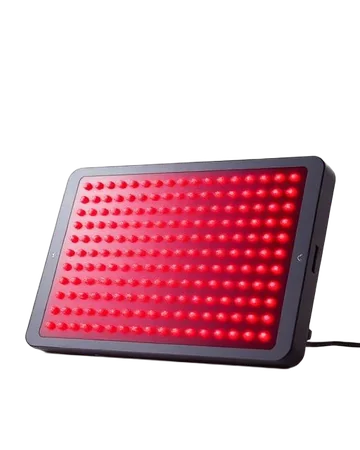
    FAQ

    Frequently asked questions

    What is the difference between 660 nm and 850 nm light?

    660 nm is visible red light and penetrates the skin roughly 1–4 mm — used for skin, scars, scalp and wounds. 850 nm is near-infrared (invisible) and passes through tissue roughly 3–5 cm — used for muscles, joints and deeper pain areas. Combo therapy (660 + 850 nm simultaneously) combines superficial and deep effects.

    How often can red light be used?

    For most areas, 3–5 sessions per week is enough — tissues need recovery time between exposures. Skin and face protocols tolerate 4–5 sessions weekly, while deep joint work usually stays at 3 per week. Daily use does not speed up results, and overly frequent exposure can actually reduce the response due to the biphasic dose curve.

    Is red light therapy safe?

    660 and 850 nm are non-ionising light with no known long-term harm when guideline times are followed. Eyes should always be protected from direct exposure — bright light can damage the retina. Pregnancy, active cancer, photosensitising medication and undiagnosed symptoms warrant a medical review first. Mild warmth on the skin is normal; stinging or redness means the session was too long.

    Why does too much dose weaken the result?

    Red light follows a biphasic response (Arndt–Schulz law): a small dose activates mitochondria, but too much overloads them and produces oxidative stress. In wound-healing studies, 2 J/cm² promoted healing while 50 J/cm² slowed it. More is not better — recommended times reflect the dose that gives the best biological response, not the maximum tolerated.

    Can red light be used on the eyes?

    Yes, but only under conditions. The 850 nm near-infrared must be turned off, because it is invisible and the blink reflex does not limit exposure. The protocol is 660 nm alone, from at least 30 cm, 20–60 seconds once per day in the morning. The evidence covers the method, not this device: research devices delivered 8–40 mW/cm², and the panel's radiance has not been measured for ocular use. Diagnosed eye disease belongs with an ophthalmologist. See the conditional eye protocol on this page in full.

    Can red light treat canker sores or oral ulcers?

    The evidence here is strong, but the dose is delivered with an intraoral tip directly against the mucosa at just a few J/cm² per point. A panel does not reach the mucosa and does not pass through the cheek at a therapeutic dose. The TMJ protocol on this page targets the joint and masseter under the skin, not the mucosa. Oral mucosa issues belong with a dentist.

    Is red light safe for the thyroid?

    The thyroid sits superficially at the front of the neck and is unavoidably exposed if the neck is lit from the front. Hashimoto's studies show promising results in supervised clinical use, but that does not justify home use over the thyroid. If you have thyroid disease, nodules or thyroid medication, talk to a doctor before lighting the neck. For neck and shoulder work, aim from behind.

    👁️ Protect your eyes — except in the conditional eye protocol

    ⚖️ Too much weakens results — follow guideline times

    🏥 Acute symptoms → healthcare professional